Why Pre-Med Students Really Take Gap Years (Data From 328 Students) And How to Make Yours Count
Arush Chandna, Co-Founder of Inspira Advantage
Why Pre-Med Students Really Take Gap Years (Data From 328 Students) And How to Make Yours Count
After working with thousands of pre-med students over the past several years, I’ve noticed more and more students choosing to take gap years. The stereotypical reason students pursued gap years was to “find themself,” travel, or simply enjoy some freedom before the long road ahead.
But from what I was seeing among students, that no longer seemed to tell the full story. They were using the time to strengthen weak spots in their applications. But a pattern you notice across hundreds of conversations is still just a pattern you've noticed. We wanted numbers.
So, my med school admissions advising team and I surveyed 328 students and recent graduates about whether they had taken or considered taking a gap year and why they chose to do so.
Almost half (48.8%) of the respondents had already taken a gap year or were currently in one, and 73.5% had considered taking one. More importantly, the most common reason wasn’t travel or self-discovery. It was to gain work experience.
Below, I’ll dig deeper into what students are actually doing during their gap years and how pre-med students can use that time to strengthen their medical school applications.
The #1 Reason Pre-Meds Take Gap Years: Work Experience
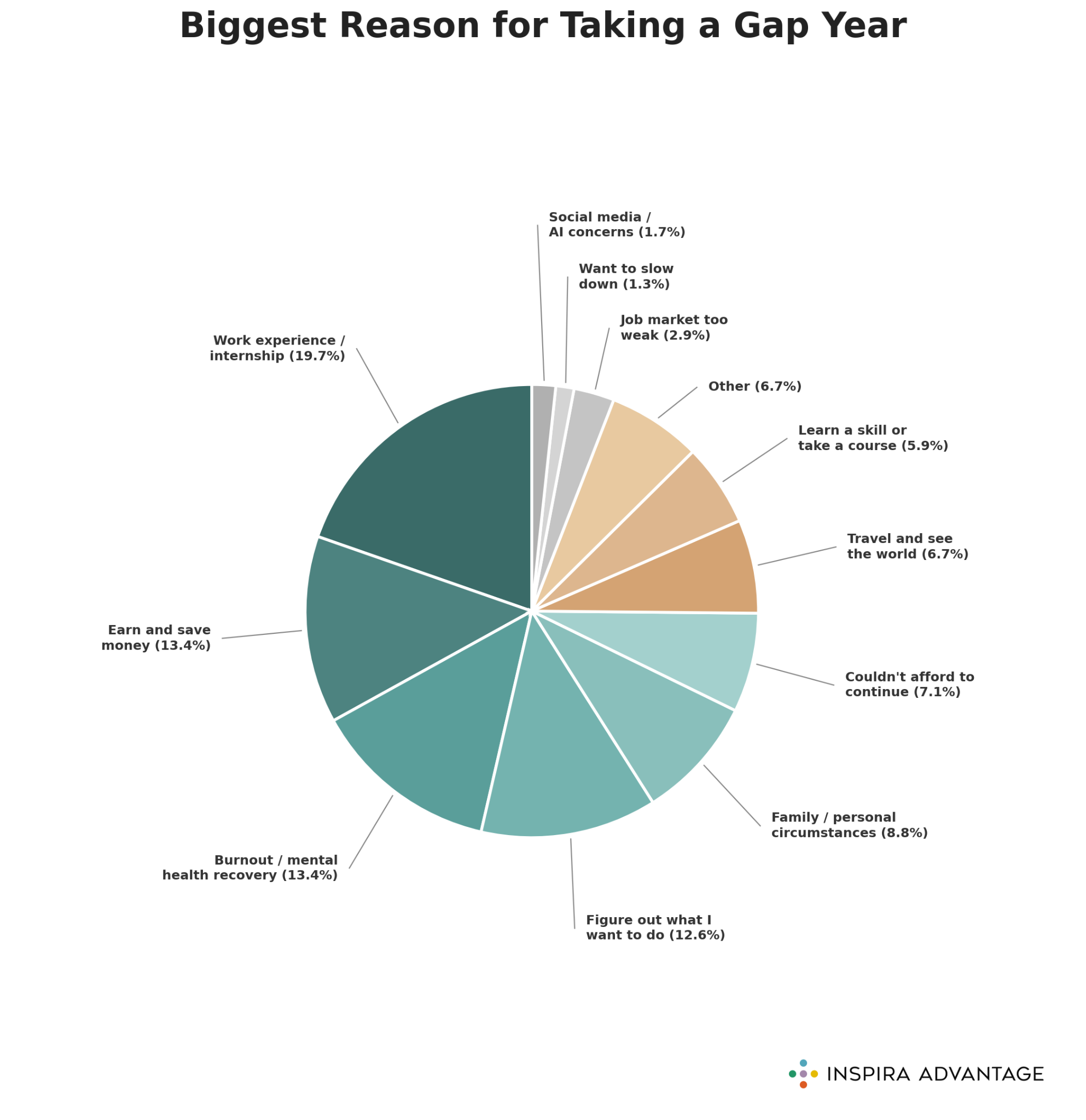
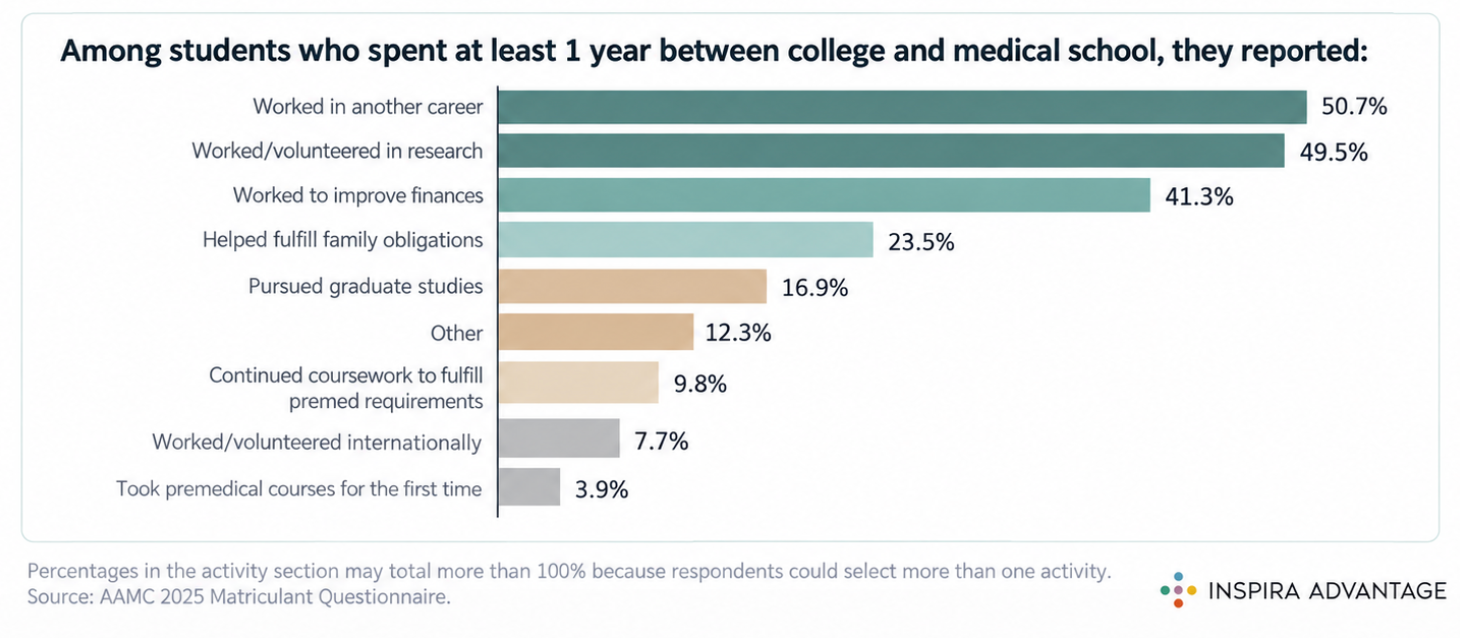
Almost 20% of the students surveyed chose work experience as the leading reason to take a gap year. Earning and saving money and recovering from burnout or mental health strain came in second at 13.4% each. Career clarity was the third most popular reason, at 12.6%. The latest AAMC data shares similar findings in their matriculant questionnaire. In 2025, only 27.3% of respondents entered medical school less than a year after graduating from college. In other words, 72.7% had at least one year between college and medical school.
And what were they doing during that time? Among respondents who spent at least one year between college and medical school, 50.7% worked in another career, 49.5% worked or volunteered in research, and 41.3% worked to improve their finances. Another 7.7% worked or volunteered internationally. Respondents could select more than one activity, so these experiences likely overlapped.
When I spoke with our admissions team about what this means for pre-med students planning their own gap years, Callie Ginapp, a med school admissions consultant at Inspira Advantage and former Yale School of Medicine admissions committee member, emphasized that how you spend the time matters:
“More than half of students are taking gap years, and it really does matter what you do with that time. Taking a year just to relax might be de-stressing in the moment, but it can create more stress later if you have nothing to show for it. Research fellowships and clinical work are common ways to use that time productively.”
Admissions committees care less about the existence of a gap year than what you did with it. I have seen applicants collect hundreds of hours during a gap year but struggle to explain what those hours taught them, making even the most impressive-looking activities feel insignificant.
That’s why quality matters more. Even if you only pursue one experience part-time, you should be able to explain why you chose it, how it helped you better understand or prepare for medicine, and what transferable skills you gained along the way for it to strengthen your application.
How to Use Your Gap Year to Become a Stronger Med School Applicant
I. Choose Experiences That Give You Something Meaningful to Talk About
Not all gap year experiences are equal. Before committing to anything, ask what you’ll actually gain from it.
A good gap-year experience should help you understand healthcare systems or patients better, or build skills that are relevant to medical school. That can include clinical work, mentorship, research experience, community-service work, or another opportunity that lets you understand healthcare systems or patients better. Most importantly, it should give you something meaningful to reflect on in your application.
For those interested in traveling during their gap year, international experiences can be valuable too. For example, Go Elective’s international pre-med internships combine supervised physician shadowing, mentorship, and exposure to healthcare in lower-resource settings.
II. Find Paid Work That Still Builds Your Application
Our survey found that earning and saving money was one of the most common reasons students took time off. Those two priorities don’t have to compete.
Consider medical assisting, scribing, EMT work, clinical research, patient care roles, or other healthcare employment. These opportunities can help you earn money while gaining exposure to medicine.
The experts on my team also stressed that your work experience doesn’t even have to be related to medicine to count. You just need to be able to show that you built transferable skills that can still serve you in medicine, like maturity, responsibility, communication, leadership, and an understanding of real-world obligations.
III. Give Yourself Time to Actually Rest
Considering burnout and mental health recovery tied for the second-most common reason respondents took a gap year, remember that your time off can be both productive and restorative.
Give yourself room to recover, but create enough structure that you still have something meaningful to show for the year. You don’t have to pursue a full-time opportunity, but ensure you commit enough time to it to gain relevant experience and skills and feel more ready to apply.
IV. Document Your Experiences as You Go
Whatever you choose, document everything, including the dates, hours, responsibilities, important patient or mentor interactions, challenges, and other moments that had an impact on you.
Keeping notes throughout your gap year will make it easier to log these experiences into AMCAS, TMDSAS, or AACOMAS later and remember details you may want to include in your personal statement, secondary essays, and interview answers.
Conclusion
There isn’t one ‘perfect’ gap year experience. Clinical work, research, paid employment, travel, or even time to recover from burnout can all be worthwhile if the experience helps you grow and move forward.
What matters most is being intentional with your time and being able to explain what you gained from it and why it reinforced your decision to pursue medicine.
About the Author
Arush Chandna, Co-Founder of Inspira Advantage, a medical school admissions consulting company. He works with one of the nation’s largest teams of former admissions officers, physicians, and experts who help applicants strengthen their candidacy and navigate the medical school admissions process.
Article Details
Categories
Recent Articles , Dental Internships, Nursing Internships, PA Internships, Pre-health, Teaching and Volunteer Internships, Med Schools,
Author: Arush Chandna, Co-Founder of Inspira Advantage
Date Published: Sep 21, 2026
Travel with us.
Inquire Today!
Go Elective offers immersive opportunities for medical students, pre-med undergraduates, residents, nursing practitioners, and PAs to gain guided invaluable experience in busy hospitals abroad. Discover the power of study, travel, and impact.
Partners & Collaborative Ventures


